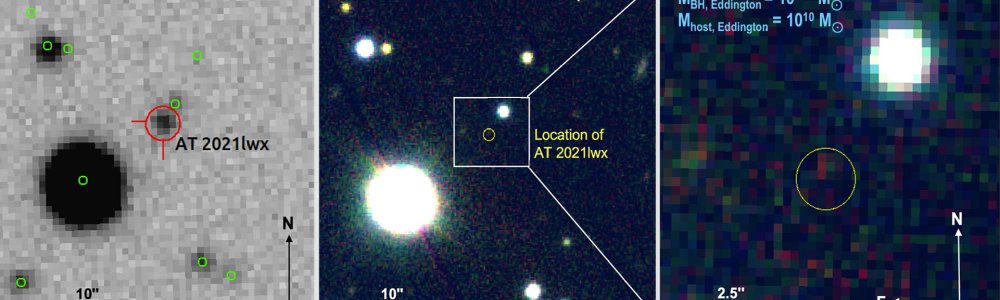
For the last few years, astronomers have been watching an explosion take place in real time in the distant universe. Called AT2021lwx (or ZTF20abrbeie), it has been massively energetic, pumping out around 100 times as much energy as the sun will emit in its entire lifetime. We usually think of cosmic explosions as lasting for weeks or even months, but AT2021lwx is on a scale not seen before. It announced itself to astronomers by remaining intensely bright over a period of years.
So it's pretty self-evident that this has been a big explosion, but its origin is a bit of a mystery. It does look a bit like a star that has been torn apart after passing too close to a supermassive black hole (SMBH), something that is known as a tidal disruption event (TDE). But it also resembles a supermassive black hole that is flaring up, or what we call an active galactic nucleus (or AGN). For that matter, it could even be something in between. The reality is that it is often difficult to classify events like this into neat little buckets, particularly when a few different things are all happening together - imagine an AGN that causes a TDE, for example.
Just to highlight the difficulty of identifying the precise cause of the outburst, different teams of scientists have drawn different conclusions. The team that discovered the event theorises that it was an AGN caused by an enormous cloud of hydrogen gas accreting onto the SMBH. Although we have seen this type of thing happen before, in this case it would have been taken to the extreme. The mass of the gas cloud itself was probably thousands of times greater the sun, with the black hole consuming vast fragments of it and sending shockwaves out into the surrounding gas and dust and causing the outburst.
A second team prefers the TDE explanation, that a massive star was torn apart after passing too close to a SMBH. The star itself would have been around 14 times the mass of the Sun, which is a very big star. The trouble is, the largest stars in the universe live fast and die young, which means that it would be quite unlikely that a star of this size could have wandered into the path of a SMBH during its short lifespan and that we would have seen it. But then, the universe is a very big place - if something can happen, it eventually will. Even the improbable.
What we do know for certain is that while this event has been called the largest explosion ever witnessed because of its longevity, it was not the brightest at its peak despite being about ten times brighter than any known supernova. That record is still held by a gamma-ray burst discovered in 2022, GRB221009A. It had a peak brightness about a billion times greater than AT2021lwx, earning it the undisputed title of the BOAT - the brightest of all time. Deservedly so.
AT2021lwx may have missed out on the title, but thanks to a fortuitous arrangement of random characters assigned to it by the Zwicky Transient Facility software (the abrbeie part of its designation), researchers nicknamed it Scary Barbie. Nice. That's even better than the officially licenced products from Mattel, although Haunted Beauty Zombie Bride Barbie comes very close. There's going to need to be some serious thought put into the naming of the next extreme event to top that.
Now, if you were thinking that discovering the biggest explosion ever would be pretty easily done by simply looking up at the sky, think again. Scary Barbie is about eight billion light years away from us, so despite the amount of energy that it has put out in our direction, astronomers still needed specialised equipment feeding data into a supercomputer running AI to find it. When it comes down to it, really it was a computer that made the discovery. And that's ok - the universe is simply too big for humans to be involved in every step of every discovery. As long as the catchy names keep coming, it's all fine with me.