Well, this is a surprise. Not just that I am writing about something other than space. But also there has been a bit of recent, positive-sounding news on climate change. Scientists have decided that the worst-case scenario, where we see average global temperatures increase by about 5.5°C by the end of the century, is now highly unlikely to eventuate. Good news, right?
Yes, it is, but it's also not quite that simple. In reality that apocalyptic scenario has been looking increasingly unrealistic for a decade or more, particularly since our reliance on coal started to decline around 2013. What we are seeing now is really just the final acknowledgement that, even if we reverse course on our energy use and burn as much coal as we can find, we still won't be able to saturate the atmosphere with enough carbon dioxide, methane, nitrous oxide, and fluorinated gases to reach that level of warming. Even if we did have enough coal in the ground, it's simply not economical to burn it all - and who can argue with money?
Does that mean that the Intergovernmental Panel on Climate Change (the IPCC) just got it wrong because they don't know what they are doing? The problem with framing it as such is the implication that perhaps the science is still unknown, or that the people working through the problem have ulterior motives. It's a pretty small leap from there to a climate conspiracy. Maybe the 5.5°C warming scenario should have been off the table years ago, and for that matter, maybe some other of the IPCC climate scenarios also rely on some debatable assumptions, but we have what we have for now. The onus is on other scientists to produce evidence that is sufficiently compelling that any remaining points of conjecture are resolved. That's how science works.
But let's also acknowledge that we have known for decades that pumping greenhouse gases into the atmosphere causes the Earth to warm. It's just math, with a bunch of modelling based on physics, chemistry, and fluid dynamics. But, math. The Sun's energy hits the Earth, the Earth radiates that energy back into space, greenhouse gases trap some of the energy and the Earth warms. Add numbers, use a calculator, and you can work out fairly precisely what the temperature rise will be. We can even calculate that without any greenhouse effect the Earth's average surface temperature would be -18°C. Yes it's true - we need a greenhouse effect to survive. Just not one that gives us an additional 5.5°C of warming. The only real areas of uncertainty in the modelling are related to the feedback loops. Melt the ice caps, and the Earth becomes less reflective. Thaw the permafrost, and release more methane.
Back to the IPCC. The latest what-if models, or climate scenarios, are known as SSPs (shared socioeconomic pathways). These combine human narratives like population growth and a willingness to shift towards sustainable practices, with the raw physics of RCPs (representative concentration pathways) that focus directly on the math. So, you could have SSP2-4.5 for example, which would mean a scenario where things progress basically as they have been (the '2') and result in a radiative forcing (meaning the difference between energy in and energy out) of 4.5 W/m2 (the '4.5' in SSP2-4.5 - this is just the equivalent of what was previously RCP4.5). It is RCP8.5 and its assumption that there'd be an eight-fold increase in our reliance on coal for energy that the IPCC has axed.
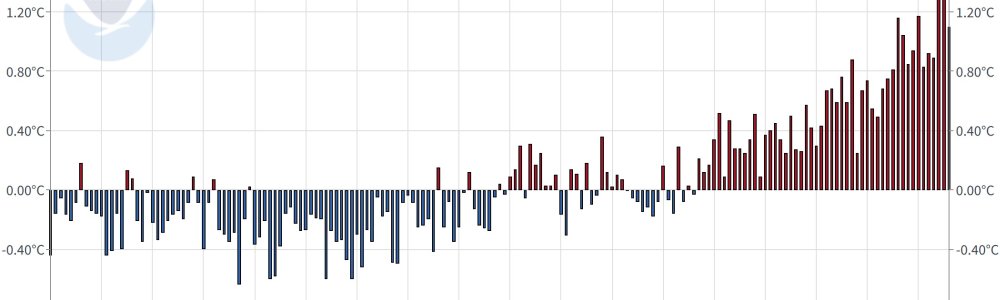
That leaves scenarios RCP1.9, 2.6, 4.5 and 6.0, where each represents an increasing level of warming expected by 2100. At this point it is not too controversial to say that it is almost certain that we will exceed the 1.5°C target set by the Paris Agreement, even if there is a universe in which this increase would just be temporary. To prevent it from becoming permanent, in addition to further reducing our reliance on fossil fuels, we'd also need to develop new, scalable technologies to actively suck the problematic gases back out of the atmosphere. The challenge now is that we are arriving at the 1.5°C threshold much faster than we'd hoped. The World Meteorological Organisation (the WMO) has calculated that there is a 91% chance we'll do that in at least one year out of the next five to 2030. One year does not make a trend, but we also exceeded that mark in 2024.
Realistically though we can probably expect the Earth to warm by about 2.5°C before the turn of the century. I'm tempted to say that would be very bad - and it will be, for much of life on Earth. Extreme weather, the collapse of ecosystems, disruptions in agriculture are all on the cards. But the Earth itself will be fine. It doesn't care what the temperature is. It has survived the Paleocene–Eocene Thermal Maximum, where average temperatures were perhaps 8°C warmer than today, and the Neoproterozoic, when ice sheets extended almost to the equator. It'll just keep doing its thing, orbiting the Sun until it is completely consumed by it in about five billion years time. And who is to say that life will not persist, adapt, and evolve in this new environment? It just might not include us.
But hey, even if no one is left to enjoy the fruits of our superior intellect - the same intellect that proved insufficient to stop us from making our own home uninhabitable - at least we'll have finally solved the Fermi Paradox. Yay for us.