The other night the passengers and crew of QF21 had a bit of unexpected excitement when an unruly passenger necessitated a detour into Tahiti, sadly though without the Pina Coladas and Mai Tais on the beach that one normally expects on arrival. While you're probably familiar with the island's reputation as a tropical paradise, a few hundred years ago it was much more than pristine waters and glorious sunsets - it was a focal point of, not quite a space race, but as close as they got back then. In the 1700s the race was on to do something that is only possible roughly twice each century - watch Venus as it moves across the face of the Sun. And Tahiti was considered to be a prime location for doing just that.
If you're wondering what all the excitement was about, well, this was a time a long ago in the era Before Detailed Sky Mapping. Anyway, we didn't really know how far the Sun was from the Earth, and the phrase 'a very long way' just wasn't cutting it with astronomers anymore. By watching Venus (a very small dot) pass in front of the Sun (a very large dot) some smart people could do a bit of mathemagic and work out the distance using a technique known as parallax. But for parallax to work, you need to take measurements from a bunch of different locations on the Earth, all at the same time.
So, after Edmund Halley (the comet guy) managed to figure out how this would all be possible, and then also managed to die just 19 years before the transit (he was 85), some 200 astronomers from around the world readied their telescopes and pointed them at the sun (please don't try this at home). It was 1761 and a watershed moment in astronomy, mostly because there was a lot of water (ie. rain) and no-one really saw a thing. At least, they didn't see much, apart from clouds. Luckily the twice in a century event was happening again in 1769, so with renewed vigour and determination plans were made to ensure observations of this next transit would be successful.
Expeditions were launched to Siberia, India, Mexico, St Helena (today the home of one of the world's most remote airports - but I digress), and somehow a certain Captain James Cook scored Tahiti. His mission included a packet of secret instructions to be opened only after leaving the island - find Australia (spoiler alert - he found it). So, get from England to Tahiti, then open an envelope there that reveals your next destination. Who was to know this would become a successful reality TV format in the 21st century? But while Cook lapped up the local hospitality in paradise as he waited for the transit, the other expeditions weren't having quite so much fun.
A Frenchman, Chappe d'Auteroche (I'm not convinced that's a real name), watched the 1769 transit from the Baja California peninsula. After journeying into Siberia to watch the 1761 transit, he obviously decided the cold wasn't his thing. On that trip the spring floods had been particularly severe, and the local peasants blamed the French 'wizard' with his strange equipment who was clearly messing with the Sun. You could do that in the 1700s. d'Auteroche at least had the protection of an armed guard while he made his observations, and despite the otherwise poor weather managed to be one of the few astronomers to view the entire transit. In comparison his 1769 expedition was completely uneventful - that is, until there was an outbreak of Typhus as he was packing to leave. He made the decision to stay and help the sick but unfortunately contracted the disease himself and died an untimely death, albeit in a state of contentment having witnessed the transit.
Le Gentil, another Frenchman (and sometimes called the unluckiest man in science), didn't do much better. Before arriving in India to observe the transit, the British captured the French colony there forcing him to return to Mauritius. Rather than go home, he decided to stay on and study Indian Ocean cultures (which I'm certain is a euphemism for 'he got a pretty girl pregnant') and subsequently missed both the 1761 and 1769 transits altogether. There went his life's work. When he finally did go home, he found he had been declared legally dead and no amount of appearing to be alive was going to change anyone's mind (including his closest relatives who had absconded with most of the dead/live man's estate). At least, not until he parted company with a substantial amount of his remaining personal wealth.
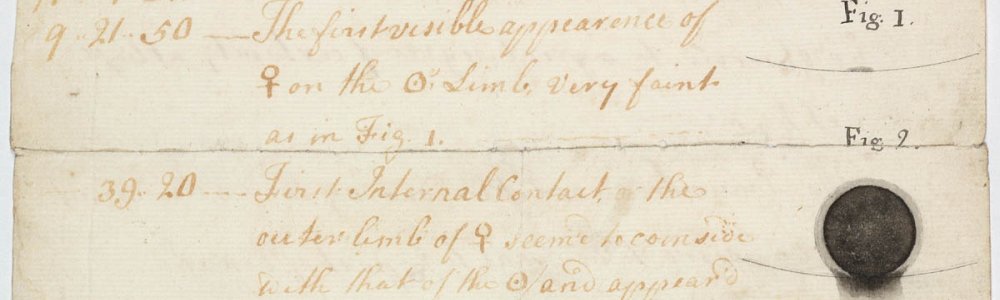
But Cook recorded the transit, writing in his journal that 'not a Clowd was to be seen the whole day and the Air was perfectly clear'. I mean, great achievement and all, but did this Englishman fail English? To be fair, in the 1700s, spelling was basically just vibes - the dictionary was yet to go mainstream. And that would be the end of the story, except that the Royal Society, whose actual motto (Nullius in verba) translates to 'take nobody's word for it' and who once conducted an experiment to find out if 'unicorn horn powder' could really neutralise poison (it couldn't), marked Cook's results a fail. Cook took exception to this slight on his professional abilities, but we don't know what he said because once they removed the 'strong' language there was nothing left to transcribe into the official records.
Another astronomer, Hornsby, ignored the Royal Society and went ahead and used Cook's results to calculate the distance to the Sun, arriving at a figure of 93,726,900 English miles. His paper read that this was 'as accurate a determination of the Sun's diftance, as perhaps the nature of the fubject will admit'. Again, vibe spelling. But compare that distance to the radar-based value we use today of 92,955,000 miles. Not a bad result in hindsight. The previous best estimate, derived in the 17th century by measuring the parallax of Mars, had been about 85,500,000 miles (haha, they were so uneducated back then). So if you manage to get to Tahiti when the Sun is out, and if it happens to be the year 2117, first of all, good on you, but second you can go to a place called Point Venus and relive the whole thing. Complete with Pina Coladas and Mai Tais.
TL;DR - If you want to measure the solar system, where better to do it from than an island paradise