Betelgeuse is possibly the most talked about star in the night sky. It might be the best known, and it's certainly one of the showiest. It's usually the 10th brightest star we can see, but it does go through very well publicised (at this point) cycles of brightening and dimming. A pulsating variable star, Betelgeuse changes in size and temperature with a period of about 6.4 years. But this is complicated by other pulsations that occur roughly annually, along with more chaotic fluctuations due to enormous convective hot spots on the star's surface. In a word, you could say that the appearance of Betelgeuse is, well, complicated, and we still don't know exactly what causes all of its variations.
Just to prove that it is a star beholden only to itself, and not to humanity's still incomplete understanding of asteroseismology, 2019 marked the start of a period during which the star dimmed quite unexpectedly and to levels not recorded before. This was the Great Dimming event and lasted into 2020, during which Betelgeuse dropped out of the top 10 brightest stars in the sky to somewhere outside the top 20.
The popular media were all over this and quickly began speculating that the star was about to go supernova, which (it must be said) is not wrong. It's just that 'about to' means something very different in the context of a human life than it does to the age of a star. According to the best models we currently have, Betelgeuse is about to go supernova, sometime within the next 100,000 years. So, you know, any day now.
And what a light show it's going to create when it finally does. It'll be as bright as a half-moon and probably remain visible for months. When SN 1006 lit up the sky (in the year 1006, obviously) it was visible as a bright disk perhaps three times the size of Venus and could be seen clearly in the daytime. We don't know exactly how bright an explosion Betelgeuse will create, but it could well equal or even exceed SN 1006.
But let's leave this speculation behind for now and speculate over something else. Astronomers have long suspected that Betelgeuse, with its periodic variations in brightness, might have a companion star. If it did, whenever this companion moved between us and Betelgeuse it would block some of its light, making the star appear dimmer and explaining some of its periodicity.
But would it ever be possible to photograph this companion, if it did indeed exist? Betelgeuse is so bright that surely it would overwhelm the light of any nearby object. And besides, the star is so enormous that if it were at the centre of our Solar System, it would extend almost all the way to Jupiter. Any companion star would need to orbit inside of its extended atmosphere. Capturing its image just doesn't seem possible.
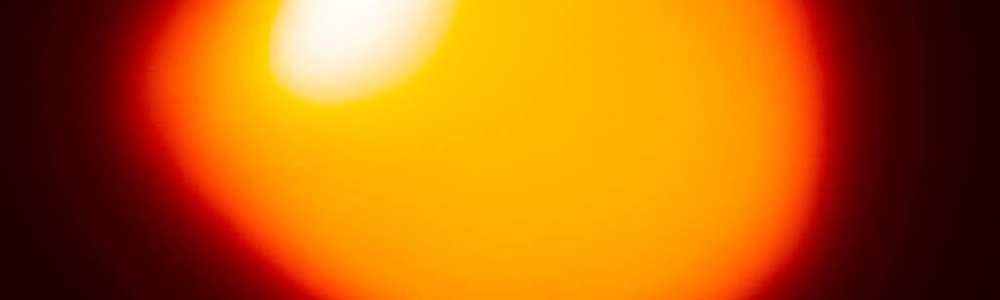
In your face, Betelgeuse. We got a picture of a star.
Ok, maybe not a star exactly, more like a speck - a pixel, if you will. On a grainy image. Which is clearly Betelgeuse's companion. Or, just putting this out there, could it be an unrelated nearby star in the foreground of the picture?
Well researchers have done the analysis and with 1.5-sigma certainty, they say it is Betelgeuse's companion star. To put this in context, 1.5-sigma certainty is also known as 'a hint of a thing that may or may not be there'. Normally in astronomy we want a 5-sigma result before anyone gets too excited and the d-word (discovery) is floated around, but in this case there is a very reasonable chance that the result is just a statistical fluke.
Still, the researchers did come up with a nice name for the maybe companion star - Siwarha, which means 'her bracelet'. Given that Betelgeuse is thought to derive from an Arabic phrase meaning 'the hand of the giant', that's actually kind of nice. On the basis of the name (but not the statistical analysis) I'll let them have their discovery - for now.